
Views: 0 Author: Site Editor Publish Time: 2026-02-16 Origin: Site


An overland belt conveyor is an essential system used in many industries for transporting bulk materials over long distances. These conveyors are crucial in industries like mining, quarrying, cement production, and aggregate handling, where the need to move large volumes of material efficiently, over varying terrains and long distances, is paramount.
In this article, we will explore what overland belt conveyors are, how they work, their key features, advantages, applications, design options, and maintenance requirements. By the end, you'll have a comprehensive understanding of why overland belt conveyors are indispensable in modern bulk material handling operations.
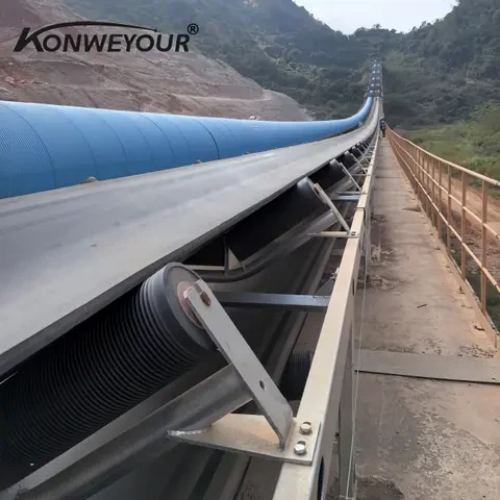
Overland belt conveyors operate on a simple but highly effective principle: they use a continuous belt system to transport materials across varying distances and terrains. The system consists of several key components, including belts, pulleys, motors, and idlers, which work together to move materials smoothly and efficiently.
Conveyor Belt: The belt is the main component, designed to transport materials. It can be made from various materials, such as rubber, PVC, or steel, depending on the material being transported.
Pulleys: Pulleys guide the belt and help maintain tension. They are typically located at the start, middle, and end of the conveyor to ensure the belt runs smoothly.
Idlers: These rollers support the conveyor belt along its length and ensure it runs properly by providing the necessary support and tension.
Motors and Drives: Motors are used to power the conveyor, while the drives control the speed and movement of the belt.
Conveyor Frames: The frames hold all the components in place and support the structure of the conveyor.
The conveyor belt moves continuously over pulleys and idlers, carrying materials from one point to another. Material is fed onto the belt at the beginning of the conveyor system, and gravity, combined with the continuous movement of the belt, allows the materials to be transported over long distances. As the belt moves, the material is carried along and discharged at the other end of the system.
Component | Function | Description |
Belt | Transports material | Made from rubber, PVC, or steel, depending on material type |
Pulleys | Directs and maintains belt tension | Located at the start, middle, and end of the conveyor |
Idlers | Provides support and helps with belt tension | Rollers that support the belt along its length |
Motors | Powers the conveyor system | Electric motors control the speed and movement of the belt |
Conveyor Frames | Structural support for all components | Holds all the components in place and maintains structural integrity |
Overland belt conveyors are built with specific features that make them suitable for long-distance transport of bulk materials. These features provide significant advantages over traditional transport methods, such as trucks or loaders.
One of the defining features of overland belt conveyors is their ability to transport materials across long distances with minimal need for intermediate handling or transportation. Overland conveyors are ideal for projects where materials need to be moved across large areas, such as from mines to processing plants, or across large construction sites.
Up to 20 km or more: Overland belt conveyors can be designed to span distances of several kilometers, reducing the need for multiple transport vehicles and intermediate storage.
Overland conveyors are built to withstand harsh environments and continuous operation. They are designed with heavy-duty components that ensure reliable performance, even under demanding conditions such as high temperatures, heavy loads, and rugged terrains.
Built for Heavy Materials: They can handle large volumes of heavy materials such as coal, ore, gravel, and cement, making them perfect for mining and quarrying operations.
High Strength: Conveyor belts are designed for high tensile strength, ensuring that they can carry heavy loads without stretching or breaking.
Overland belt conveyors are known for their energy-efficient operation. They are designed to minimize energy consumption, which is essential in long-distance transport systems. These systems use optimized motors and high-efficiency drive mechanisms to reduce operational costs.
Reduced Power Consumption: Unlike trucks, which consume fuel for each trip, overland conveyors operate continuously and can be powered with electricity, which is often more efficient.
Regenerative Drives: Some modern systems use regenerative drives that capture excess energy from the system’s braking and return it to the grid, improving overall energy efficiency.
Feature | Overland Belt Conveyor | Traditional Transport Methods |
Distance | Can span distances of up to 20 km or more | Limited by the capacity of trucks or other transport vehicles |
Durability | Built for heavy-duty, continuous operation | Trucks and other vehicles require regular maintenance |
Energy Efficiency | Optimized motors and drives reduce power usage | Higher energy consumption due to fuel-based operation |
Environmental Impact | Reduced emissions and minimal environmental disruption | High emissions and environmental impact due to fuel consumption |
Overland belt conveyors offer numerous advantages over other material transport methods, including trucks and loaders. These advantages include cost-efficiency, environmental sustainability, and increased safety.
Overland belt conveyors significantly reduce operational costs by eliminating the need for trucks, loaders, and manual labor. Some of the key cost-saving benefits include:
Lower Fuel Costs: Unlike trucks, which require fuel for each trip, overland conveyors run on electricity, reducing fuel costs and improving overall cost-efficiency.
Reduced Labor Costs: Automation of material transport reduces the need for manual labor, lowering wage costs and minimizing the risk of human error.
Overland belt conveyors have a smaller environmental footprint compared to traditional transport methods. Their continuous operation, low energy consumption, and minimal emissions contribute to more sustainable industrial practices.
Lower Emissions: Overland conveyors reduce the need for diesel-powered trucks, significantly lowering emissions and improving air quality around mining or industrial sites.
Reduced Noise and Dust: Overland conveyors produce far less noise and dust compared to trucks, contributing to a safer and more comfortable working environment.
The automation of material transport reduces the need for workers to handle materials manually or drive trucks in hazardous conditions. This increases overall safety and reduces the risk of accidents.
Automated System: Overland conveyors operate continuously without requiring constant worker intervention, reducing the exposure of workers to dangerous environments.
Minimal Traffic on Roads: By eliminating truck transport, overland conveyors reduce the number of vehicles on site, further minimizing traffic-related accidents.
Advantage | Overland Belt Conveyor | Traditional Transport Methods |
Cost Efficiency | Lower fuel and labor costs | Higher fuel costs and labor expenses |
Environmental Impact | Reduced emissions, dust, and noise | Higher emissions, dust, and environmental disruption |
Safety | Automation reduces worker risk | Increased risk due to manual labor and truck operation |
Overland belt conveyors are widely used across several industries for bulk material transport. They provide an efficient solution for long-distance material handling, reducing the need for traditional methods that are more labor-intensive and costly.
In the mining industry, overland belt conveyors are used to transport ore, coal, and other materials from extraction sites to processing plants. Their long-distance transport capability and durability make them ideal for use in large mining operations.
In cement plants, overland belt conveyors transport limestone, clay, and other raw materials across large sites. Similarly, in the aggregate industry, they are used to move sand, gravel, and stone over long distances from quarries to processing facilities.
Overland conveyors are also used in large construction projects to move building materials across the site. They help reduce the reliance on trucks and provide a more efficient, cost-effective solution for material transport.
Industry | Application | Material Transported |
Mining | Transporting ore and coal | Ore, coal, minerals |
Cement | Moving raw materials across the plant | Limestone, clay, gypsum |
Aggregate | Moving sand and gravel | Sand, gravel, stone |
Construction | Transporting construction materials | Cement, aggregates, building materials |
Overland belt conveyors are highly customizable to meet specific operational needs. Various design options can be implemented to accommodate different terrains, material types, and operational conditions.
Overland conveyors can be designed to span long distances, with lengths that vary depending on the site’s requirements.
Conveyors can also be customized to navigate uneven terrains, such as hills or valleys, ensuring material is transported efficiently.
Material Type: The choice of belt material (rubber, PVC, steel, etc.) depends on the type of material being transported and the environmental conditions.
Belt Strength: The strength of the belt is chosen based on the load and distance of transport. High tensile strength belts are used for heavier materials.
Overland belt conveyors can be seamlessly integrated with other material handling systems, such as stacking systems, crushers, or screening systems, to form a comprehensive material handling solution.
Customization Option | Overland Belt Conveyor | Traditional Transport Systems |
Route and Length | Can span distances over 20 km | Limited to shorter distances or confined spaces |
Belt Material | Customizable for different materials and conditions | Often limited in material types and strength |
System Integration | Can be integrated with other systems (e.g., crushers) | Less adaptable and may require additional equipment |
Overland belt conveyors are designed for long-term operation with minimal maintenance. However, like any industrial equipment, regular maintenance is required to ensure optimal performance and longevity.
Belt Inspections: Regular checks are required to ensure the belt is in good condition, with attention paid to wear and tear, especially in high-stress areas.
Pulley and Idler Checks: Pulleys and idlers should be inspected for damage and alignment to prevent operational failures.
Motor and Drive System Maintenance: Motors and drives should be periodically checked to ensure efficient operation.
Maintenance Task | Frequency | Purpose |
Belt Inspection | Monthly or as needed | Check for wear, tears, and alignment issues |
Pulley and Idler Check | Quarterly | Ensure smooth operation and prevent belt misalignment |
Motor and Drive Maintenance | Annually | Prevent failures and ensure energy-efficient operation |
Overland belt conveyors are essential for efficient, cost-effective, and sustainable bulk material transport. They offer long-distance transport capabilities, ensuring reliable performance while significantly reducing fuel, labor, and environmental impact. These conveyors provide an ideal solution for industries requiring the transportation of bulk materials over vast distances, offering substantial savings and greater operational efficiency.
At Hebei Konweyour Import and Export Co., Ltd., we specialize in providing high-quality overland belt conveyors designed to meet the specific needs of your operation. With customizable options, energy-efficient components, and low maintenance requirements, our conveyors are built to support the demands of industries such as mining, cement production, and large-scale construction projects.
We invite you to get in touch with us to learn more about how our overland belt conveyors can improve your material handling operations. Our team is ready to provide tailored solutions and expert guidance to help you achieve your goals.
Q1: What is the primary function of an overland belt conveyor?
A1: The primary function of an overland belt conveyor is to transport bulk materials efficiently over long distances, especially in industrial operations like mining and construction.
Q2: How does an overland belt conveyor reduce costs for industries?
A2: Overland belt conveyors reduce costs by eliminating the need for trucks and labor, leading to savings on fuel, wages, and maintenance. They also operate continuously, minimizing downtime.
Q3: What materials can be transported using overland belt conveyors?
A3: Overland belt conveyors are designed to transport a wide range of materials, including coal, ore, gravel, cement, and other bulk materials.
Q4: How energy-efficient are overland belt conveyors?
A4: Overland belt conveyors are energy-efficient because they use optimized motors and drive systems, and unlike trucks, they run on electricity, which reduces energy consumption.
Q5: How are overland belt conveyors customized for different terrains?
A5: Overland belt conveyors are highly adaptable and can be designed to navigate uneven terrain, slopes, and long distances, ensuring materials are transported efficiently even in challenging conditions.


